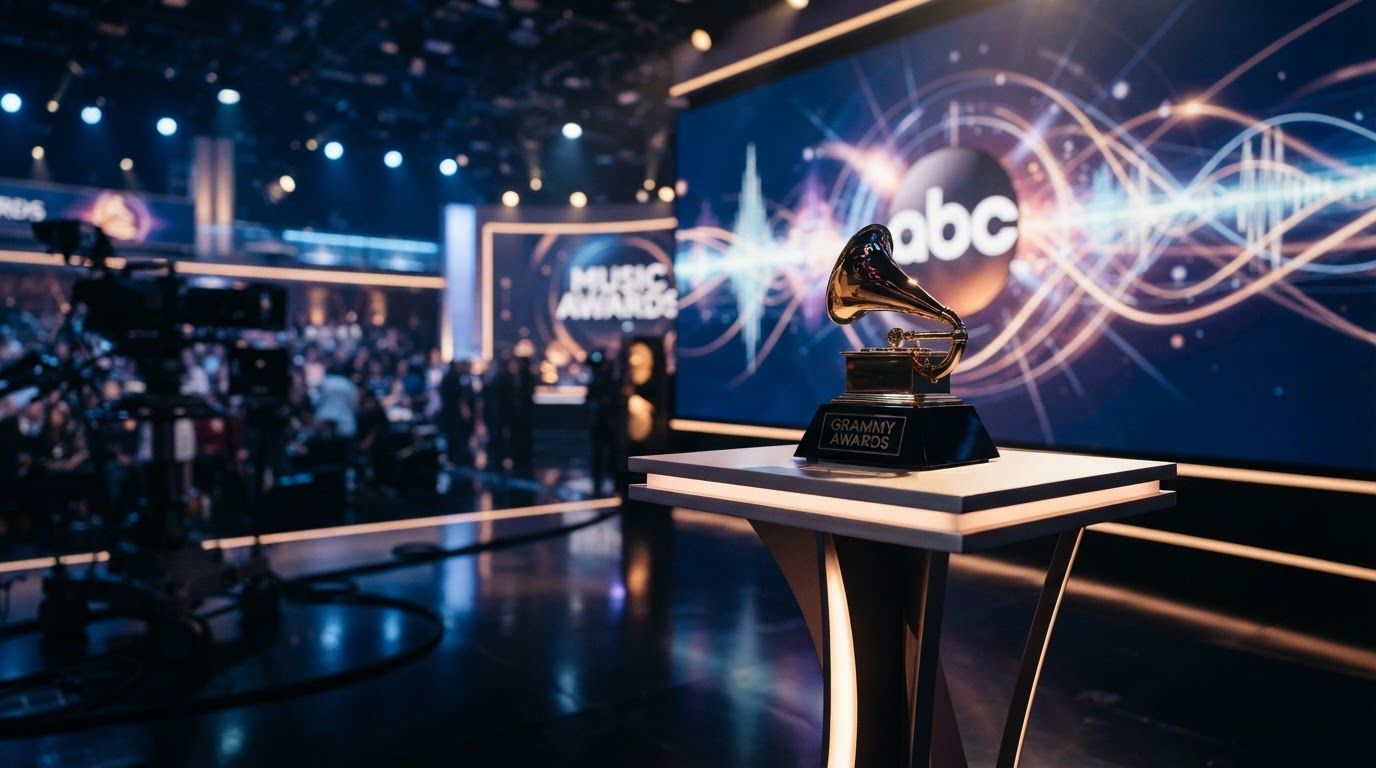
The Grammys’ move to ABC could change more than where viewers find the ceremony. Beginning in 2027, the awards will enter a 10-year Disney deal that also places the show on Hulu and Disney+, creating an opportunity to rethink how a live music event reaches people before, during, and after the broadcast.
The important question is not whether a new network alone can make an awards show feel essential. It is whether the Recording Academy and Disney can combine broadcast reach, streaming access, shareable performances, and a credible awards process without turning the Grammys into an event that feels designed mainly to promote a platform. The first ABC ceremony will offer an early test, but the implications extend through the deal’s run to 2036.
What the Grammys’ move to ABC actually changes
The clearest immediate change is distribution. The 2026 ceremony was the final Grammy telecast on CBS, ending a partnership that lasted roughly half a century. The 2027 show will be the first ABC broadcast of the Grammys since 1972, with Hulu and Disney+ also part of the new Disney arrangement.
Direct answer: The Grammys’ move to ABC could reshape the awards by making the ceremony a broadcast-and-streaming event, giving performances more paths to reach viewers, encouraging additional Grammy-branded programming, and prompting a fresh look at the telecast’s format. The network switch does not, by itself, resolve questions about award categories, artist participation, or the value of a nomination.
Those distinctions matter because a television-rights deal and an awards institution are related but not identical. Disney can provide places to show and promote Grammy programming. The Recording Academy still has to make decisions about the awards and sustain the confidence of artists, voters, and audiences in those decisions.
Recording Academy chief executive Harvey Mason Jr. has said the Disney opportunity would make the Academy “look at everything we’re doing.” That statement signals a wider review than simply replacing one broadcaster’s logo with another. It does not specify which practices will change, so the useful question is where the new distribution arrangement creates room for choices the Academy may not have made before.
Think of the transition as three connected layers: the live ceremony that people watch together, the digital material they encounter around it, and the institution that selects and honors the music. ABC, Hulu, and Disney+ primarily change the first two layers. If the Academy also revisits the third, the consequences could be more lasting than any redesign of the stage or adjustment to the running order.
How ABC, Hulu, and Disney+ could reach different Grammy viewers
A broadcast network remains useful for a national live event because it offers a familiar destination: turn on ABC and watch as the ceremony unfolds. Streaming adds other routes into that same occasion for people who already use Hulu or Disney+. The opportunity is to make those routes complementary rather than treat streaming as a duplicate of television.
That does not mean the Grammys have to abandon the shared experience that makes a live performance compelling. A surprise pairing of artists, an emotional acceptance speech, or a widely discussed performance gains force when people see it together and react in real time. The value of the new arrangement lies in keeping that sense of occasion while reducing dependence on a single viewing habit.
The viewing experience matters as much as availability
ABC and Disney would need to decide how clearly they explain where to watch and what viewers can expect on each service. If audiences cannot tell whether a platform carries the live ceremony, highlights, or related programming, an expanded footprint may feel more confusing than convenient. Straightforward promotion and a consistent presentation across outlets would make the deal’s reach more meaningful.
There are several ways the combined distribution could work for different audiences:
- Broadcast-first viewers could continue to use ABC as a straightforward place to watch the live ceremony.
- Streaming-first viewers could encounter the Grammys through Hulu or Disney+ rather than needing a conventional television routine.
- Casual music fans might first notice a performance or related special and decide to watch more Grammy programming.
- Returning fans could follow the event across formats without treating every Grammy-related program as part of one long telecast.
These are possibilities, not reported features of the 2027 show. Their importance is strategic: a broader audience is not one uniform group waiting for the same invitation. Someone who wants to see every award presented has different needs from someone who arrives for one performer and may stay if the rest of the show earns their attention.
There is also a practical trade-off. The more a ceremony is shaped around separate platforms and moments, the easier it may be to reach people who would not commit to the whole show. But if the telecast becomes only a collection of clips waiting to happen, viewers may lose the reason to experience the awards as a complete live event. The strongest use of ABC and streaming would preserve both an accessible main show and compelling ways into it.
Why Grammy clips and social media rights matter after the network switch
For a music awards show, distribution does not end when the live feed stops. A performance can prompt conversation well beyond the telecast, while a speech or an unexpected collaboration can become the moment through which people remember the night. How quickly audiences can see and share those moments affects the cultural reach of the ceremony.
Reported CBS-era negotiations included pressure to delay social-media clips until after the live show. That detail illustrates a real tension: a broadcaster has reason to protect the value of watching live, while the Academy and participating artists may benefit when moments circulate quickly. The Disney deal creates an opportunity to revisit that balance, but no particular clip-release policy should be assumed from the network change alone.
The choice is not simply live viewers versus online viewers
Holding back a clip might encourage some fans to tune in for the full performance. It might also miss the period when conversation is most active, especially for people who are learning that a performance happened through friends or social feeds. Releasing a polished excerpt promptly could pull those people toward the broadcast or streaming experience, but a flood of complete segments might give others little reason to watch the ceremony itself.
A more useful way to evaluate the approach is to ask what each kind of material is meant to do. A short clip can spark interest; a complete performance can satisfy a fan who missed the live show; a broader collection of highlights can help viewers understand the night as a whole. Those roles need not be identical, and their timing can be considered separately.
- Make discovery easy: Let a noteworthy Grammy moment be recognizable and findable when audiences are discussing it.
- Give the live show a reason to exist: Preserve the suspense, sequencing, and performances that make watching together different from browsing afterward.
- Respect the people onstage: Present performances and speeches with enough context that an isolated clip does not distort what happened.
This is where the ABC era could feel genuinely different even if the ceremony itself remains familiar. A well-produced show that is difficult to encounter outside its original airing has a different public life from one whose best moments are easy to find. Conversely, easy circulation cannot compensate for moments that feel manufactured or for an awards process people do not trust.
Could ABC change the Grammys’ host, pacing, and live-show feel?
The last CBS Grammys demonstrated the appeal of major star power, but the telecast also retained a long-form awards-show structure. Media reviews suggested that ABC might consider a different host style or pacing to refresh the event. That is a question about editorial design, not evidence that a particular host or format has already been chosen.
Pacing is especially difficult for the Grammys because the show serves several purposes at once. It recognizes winners, stages performances, gives artists room to speak, and tries to offer surprises to viewers who may not follow every category. Cut too aggressively, and the awards risk becoming background between performances. Keep every segment at the same weight, and the ceremony can struggle to hold the attention of people who came for live music.
A tighter show needs an organizing idea
Changing hosts or shortening transitions would be visible, but those choices would only help if producers know what kind of night they want to create. Is the ceremony primarily a showcase of current music, a celebration of recorded achievement, or a bridge between established names and less familiar artists? It can be all three, but the running order must make that combination feel intentional.
One possible approach would put more emphasis on the connections between performances and awards. A performance can illuminate why a category matters; a well-placed acceptance speech can give the following song additional meaning. Another approach would prioritize momentum, with fewer interruptions between major musical moments. Each offers a different trade-off between context and speed, and neither guarantees a stronger show by itself.
The host presents a similar choice. A prominent personality can give an evening continuity and create space for humor or reflection. A lighter hosting presence can leave more attention on the musicians and presenters. The right decision depends on how the full ceremony is structured, not simply on whether the broadcaster wants a recognizable name.
ABC’s involvement may encourage fresh thinking, but the Grammys should be cautious about treating every long segment as a flaw. Some performances need time to develop; some artists’ remarks are meaningful because they are not reduced to a quick sound bite. The goal should be to remove dead time without flattening the moments that make a live awards show worth watching.
Grammy-branded music specials could make the awards a year-round presence
The Recording Academy plans to produce more Grammy-branded music specials. That could make the Disney arrangement significant well beyond the annual ceremony: ABC, Hulu, and Disney+ offer places to introduce or extend Grammy programming, while Disney’s broader entertainment operation offers promotional opportunities. The precise shape of those specials is not settled by the deal itself.
There is a clear reason to explore them. An annual awards show asks viewers to care deeply about nominees and performances on one night, even though their relationship with music continues throughout the year. Additional programming could give audiences more occasions to engage with artists and the Grammy brand before the next set of envelopes is opened.
The opportunity also calls for editorial restraint. A special that has a distinct musical idea can stand on its own. A special that exists mainly to keep a familiar logo in front of viewers risks making the main event feel less exceptional. More programming is not automatically more relevance.
Different programs can do different jobs
- Performance-focused specials could give music room to breathe outside the ceremony’s award-and-commercial rhythm.
- Artist-centered programs could help viewers connect a musician’s work to the wider conversation the Grammys hope to host.
- Context around genres or craft could make parts of the awards process more accessible without forcing every explanation into the live telecast.
These are potential directions, not announced program descriptions. They show why the difference between an awards franchise and a single telecast matters. If a special helps people understand or enjoy music on its own terms, it may build interest in the ceremony. If every program feels like an extended advertisement for the ceremony, viewers may tune out before the main event arrives.
Disney’s promotional reach raises another useful distinction: exposure and commitment are not the same thing. Placing Grammy messaging across services could help people know when and where to watch. It cannot require them to feel invested in the winners, the performances, or the Academy’s choices. The added specials will be strongest if they offer reasons to care, rather than assuming that repetition alone will create them.
Why category changes and artist buy-in still shape the ABC era
The Academy is changing the awards themselves, not just their distribution. It announced rule changes and new categories in 2026, before the move to ABC. Those decisions will affect what the Grammys recognize and how artists understand their opportunities, regardless of whether audiences watch on broadcast television or a streaming service.
The new Best Asian Pop Music Performance category illustrates the difficulty. Category expansion can make room for music that deserves attention, but it can also provoke debate about whether a new boundary separates artists from broader fields of recognition. Both concerns deserve consideration; a new category is neither automatically inclusive nor automatically exclusionary.
That debate becomes more visible when an awards ceremony reaches people across several platforms. A wider promotional campaign can explain a category’s intent, but it may also draw more scrutiny to its definitions and to which work appears to fit. The Academy’s challenge is to make the purpose of its categories clear and demonstrate that they serve musicians rather than merely supply new ways to market the show.
Participation is part of the institution’s credibility
BTS said they would not submit for the 2027 awards, and Mason Jr. publicly responded. Without adding motives to that decision, the exchange shows why artist participation cannot be treated as a minor detail of broadcast planning. A telecast can offer a larger stage, but the people whose music gives that stage meaning still have choices about their relationship with the awards.
Viewers, too, may judge the ceremony by more than the quality of its performances. They can ask whether categories make sense, whether recognition feels meaningful, and whether the show gives artists room to be more than promotional attractions. These are questions a network partner can help communicate, but they are not questions a network partner can settle for the Academy.
That is the limit of describing the transition as a ratings solution. A broadcaster may make the Grammys easier to find and a polished telecast may make them easier to watch. Neither can substitute for confidence in why particular music is nominated, how fields are defined, or why artists choose to participate. If the ABC era leads to a broader review of the awards ecosystem, these institutional questions belong near the center of it.
What ABC’s big 2027 event lineup means for the Grammys
ABC is positioned to carry an unusually prominent set of event broadcasts in 2027: the Grammys, the Oscars, and the Super Bowl all fall within the same year. For Disney, that creates obvious opportunities to promote appointment viewing across its outlets. For the Grammys, it means the new home will already have a strong event-TV identity when the music awards arrive.
That lineup could help ABC tell a consistent story about where viewers go for major shared occasions. Someone who rarely follows awards shows may still encounter Grammy promotion while engaging with another event or using a Disney platform. Cross-promotion, however, is a doorway rather than a substitute for a distinctive show.
The three events do not serve interchangeable audiences or purposes. The Super Bowl is a sports championship, the Oscars recognize film, and the Grammys celebrate recorded music. Treating them as one generic package of big nights might increase awareness of ABC’s schedule, but it would not explain why this particular awards ceremony matters to music fans.
The more valuable advantage is operational and creative focus on live occasions. Promoting a major event requires a clear invitation, a recognizable route to viewing, and a reason to pay attention now rather than later. The Grammys can benefit if ABC and Disney apply that discipline while allowing the ceremony’s music and awards to define its identity.
There is a possible downside to the crowded event lineup as well. If the Grammys are presented mainly as one item in a sequence of prestigious broadcasts, their specific questions,who is recognized, what gets performed, and which musical communities feel represented,can be obscured. Scale should make those questions easier to address in public, not easier to gloss over.
How to judge whether the first ABC Grammys succeed
The 2027 ceremony is expected to test whether a broadcast-network home and streaming availability can renew the Grammys’ relevance without sacrificing the energy of live television. No single outcome will answer that question completely. An impressive performance, a widely discussed controversy, or strong initial attention could each shape perceptions of one night without showing whether the broader strategy works.
A better assessment would consider several kinds of success together:
- Access: Can viewers readily understand where and how to watch the ceremony across ABC, Hulu, and Disney+?
- Engagement: Does the full live show give people a reason to stay, rather than relying only on moments encountered afterward?
- Afterlife: Are performances and speeches presented in ways that let people discover and revisit them without stripping away useful context?
- Musical substance: Do the performances, awards, and any related specials add up to a compelling picture of the music being celebrated?
- Institutional trust: Do category decisions and the Academy’s relationships with artists strengthen confidence in the honors?
These questions are more informative together than any one measure of attention. A broadly viewed telecast could still leave audiences frustrated by its pacing or unconvinced by its awards. A performance that travels widely online could introduce new viewers to the Grammys, yet reveal little about whether they would watch or value the next ceremony.
The test should also extend past the first ABC broadcast. The deal runs through 2036, which gives the Academy and Disney time to learn what works across the live show, streaming distribution, clips, and additional specials. That longer horizon is an advantage if it supports careful improvement; it is less useful if each year repeats the same assumptions under a new promotional campaign.
For viewers, the most noticeable changes may be simple: where they find the show, how it feels to watch, and whether its best moments remain accessible afterward. For artists and the Academy, the stakes are wider. A successful ABC era would make the ceremony easier to encounter while keeping the recognition itself worth seeking.
The Grammys’ move to ABC is therefore a chance to rebuild the relationship between a live broadcast, a streaming audience, and a music institution. It gives Disney and the Recording Academy more ways to present the awards, but it does not predetermine whether those ways will feel coherent or credible.
As the 2027 ceremony approaches, watch for decisions rather than promises: how clearly the show is distributed, how performances circulate, what changes in its pacing, and how the Academy explains its categories. Those choices will reveal far more about the future of the Grammys than a network change on its own.
Leave a Reply